



ASTM F3161: Standard Test Method for Finite Element Analysis (FEA) of Metallic Orthopaedic Total Knee Femoral Components under Closing Conditions.
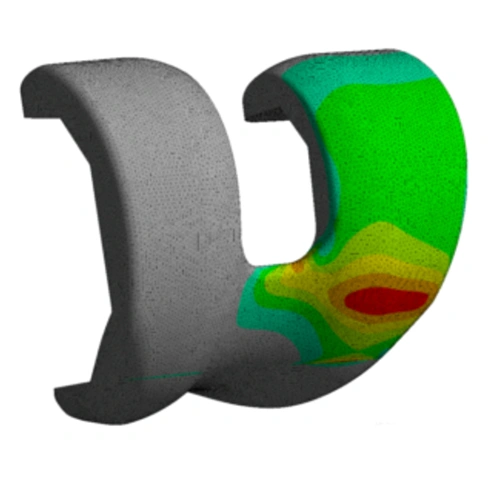
This standard establishes requirements and considerations for the numerical simulation of metallic orthopaedic cemented and cementless total knee femoral components using Finite Element Analysis for the evaluation of stresses and strains. Loads are selected to simulate closing conditions. This standard is only applicable to stresses below the yield strength, as provided in the material certification. This simulation is analogous to the physical test described in ASTM F3210 with the boundary conditions applied similarly.
The verification and validation of computational models is an essential component for an accurate simulation. To establish model credibility, EndoLab follows the guidelines described in ASME V&V40.
ASTM F3161 is used to determine the worst-case size of knee femoral component to test knee femoral components in fatigue according to ASTM F3210.
Potentially, with the right level of verification and validation (V&V), ASTM F3161 could serve as an alternative to ASTM F3210. In practice, however, ASTM F3161 is most often used to help determine the worst-case conditions for physical bench testing rather than fully replacing it.