







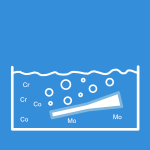

Ion concentration analysis, similar to particle analysis, is a valuable addition to wear and fatigue testing, providing a more comprehensive understanding of an implant’s overall performance and biological activity. In fact, some standards like ASTM F1875, which describes fretting corrosion tests, as well as many notified bodies explicitly list ion concentration analysis as a (required) follow-up examination.
After testing, the test fluid medium from the chambers and enclosures is collected, acidified to stabilize metal ion concentrations, and analyzed for the selected elements.
Depending on the target elements and the composition of the test fluid, one of the following analytical methods is used:
- ISO 17294-2: Water quality – Application of inductively coupled plasma mass spectrometry (ICP-MS) – Part 2: Determination of selected elements including uranium isotopes
- ISO 11885 (E22): Water quality – Determination of selected elements by inductively coupled plasma optical emission spectrometry
Before measuring the element’s concentration, the samples undergo wastewater digestion according to ISO 15587-2, ensuring that particle-bound ions are dissolved and the total concentration of each element can be accurately determined.