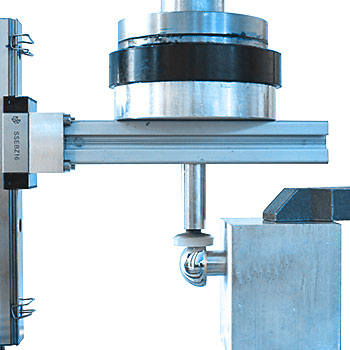











ASTM F2887: Standard Specification for Total Elbow Prostheses
ASTM F2887 covers total elbow replacement (TER) prostheses and hemi-elbow replacement (“hemi”) prostheses used to provide functioning articulation by employing humeral, ulnar, and/or radial components that allow for the restoration of motion of the human elbow joint complex.
The specification is intended to provide basic descriptions of material and prosthesis geometry. In addition, mechanical tests such as stem fatigue, component disassembly, and wear are proposed.
EXECUTIVE SUMMARY
ASTM F2887 provides a framework for the mechanical and functional evaluation of total and hemi-elbow replacement systems.
Depending on the implant design, the evaluation can include:
- fatigue performance of individual components
- resistance to disassembly or subluxation
- wear performance
- integrity of modular connections
- coating performance
- range of motion
- laxity and joint constraint
The applicable test programme depends on the implant design, fixation concept, materials and degree of constraint. Testing should use components representative of the finished device and should consider relevant worst-case conditions.
Read more…
Purpose of the specification
ASTM F2887 is intended to define important material, geometric and performance characteristics of elbow replacement prostheses.
The specification applies to systems that replace the humero-ulnar articulation and may also include replacement of the radial articulation. Both linked and non-linked systems are covered.
While it is not a single test standard, ASTM F2887 helps guide manufacturers in selecting appropriate evaluations for the specific implant design and its potential mechanical failure modes. The standard also emphasizes that compliance alone does not guarantee satisfactory clinical performance.
Mechanical performance
Elbow replacement components should be capable of withstanding the anticipated static and dynamic physiological loads associated with their intended use.
ASTM F2887 identifies several mechanical performance aspects that may require evaluation. These include fatigue of humeral, ulnar and radial components, durability of linked systems and resistance to subluxation in non-linked designs.
The exact test setup and loading conditions depend on the implant. Worst-case conditions should be considered when selecting the test configuration, particularly where loss of bony support or other mechanically demanding conditions could lead to deformation or fracture.
Stem fatigue and component durability
Stem fracture is a recognized mechanical failure mode addressed by ASTM F2887. Individual humeral, ulnar and radial components should therefore be evaluated under appropriate fatigue loading conditions where relevant.
For linked elbow prostheses, the connection between the humeral and ulnar components may also require durability testing. This can be used to evaluate whether repeated loading could lead to loss of constraint, component fracture or disassembly.
Because the standard does not prescribe one universal fatigue configuration for every elbow implant, the selected method should reflect the geometry and mechanically critical conditions of the specific device.
Wear performance
Wear of the bearing surfaces is another important aspect of the mechanical evaluation. ASTM F2887 identifies wear, delamination and fracture of bearing components as relevant failure modes.
The wear assessment should take into account factors such as:
- component size and bearing thickness
- loading conditions
- bony support
- locking mechanisms
- edge loading and misalignment
The appropriate wear methodology depends on the implant design. Where suitable, simulator-based testing may be considered to reproduce the articulation and loading of the elbow prosthesis under controlled laboratory conditions.
Modular connections
For prostheses containing modular components, the mechanical integrity of the connection mechanisms must be evaluated.
Depending on the design, this can involve static or dynamic shear testing, bending testing, tensile testing or a combination of these methods. Alternatively, the complete modular construct can be subjected to fatigue or durability testing.
Worst-case evaluation may consider component dimensions, misalignment, bearing thickness, support conditions, locking mechanisms and interactions between dissimilar materials.
Range of motion
ASTM F2887 defines functional requirements for the range of motion of elbow replacement systems.
The prosthesis should allow motion in the two principal functional directions:
- flexion and extension
- pronation and supination
For flexion and extension, the specification requires a range from full extension at 0° to 140° of flexion. For pronation and supination, a total global range of 170° is specified.
These measurements are performed with the components positioned in a defined neutral alignment, since implant positioning can influence the measured range of motion.
Laxity and constraint
Depending on the implant design, a certain amount of secondary movement between the components can be intentional. In linked elbow systems, this controlled laxity helps avoid a completely rigid connection while still maintaining joint stability.
ASTM F2887 addresses movement in:
- varus-valgus direction
- anterior-posterior and superior-inferior translation
- internal-external rotation
Constraint may also be characterized by measuring the resistance of the implant to movement in these directions.
The relevance of these evaluations depends strongly on whether the prosthesis is linked, non-linked, constrained or semi-constrained.
Coatings and bearing surfaces
Where porous or other functional coatings are used, ASTM F2887 also addresses the mechanical performance of the coating. Depending on the coating system, evaluations can include shear strength, tensile strength and fatigue behaviour.
The specification additionally defines requirements for the surface quality of metallic and polymeric bearing surfaces. These requirements are intended to ensure that the articulating surfaces are suitable for their intended mechanical function.
Evaluation
ASTM F2887 does not result in one single test value or acceptance criterion for an elbow replacement system. Instead, the mechanical evaluation is built around the relevant characteristics and potential failure modes of the specific implant design.
The overall test programme can therefore differ substantially between linked and non-linked systems, modular and monoblock components, and different fixation or bearing concepts.
Together, the selected evaluations provide information on the strength, durability, articulation and mechanical stability of the elbow prosthesis under controlled laboratory conditions.