












ISO 22622: Implants for surgery – Wear of total ankle-joint prostheses – Loading and displacement parameters for wear-testing machines with load or displacement control and corresponding environmental conditions for test
The wear of total ankle joint replacements under standard gait conditions can be determined using the EndoLab® knee joint simulator. Simultaneous testing of three (plus soak control) specimens enables rapid development, saving money and time. Routine testing is performed using bovine serum as a test fluid. In general, the test is stopped after 5 million cycles. Wear is determined by weight loss measurements. Standard inspection cycles are 0.5 million cycles. Optionally, particle analysis can be performed.
EXECUTIVE SUMMARY
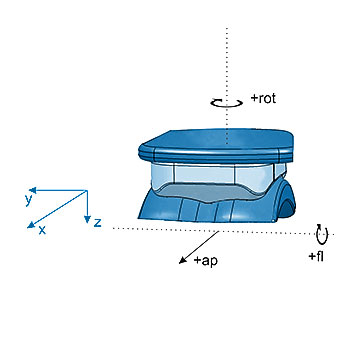
During testing according to ISO 22622, the total ankle replacement is subjected to a simultaneous combination of cyclic forces and movements representing a walking gait.
The simulation includes:
- axial loading of the ankle joint
- plantarflexion and dorsiflexion
- anterior-posterior loading or displacement
- internal and external rotation or rotational torque
The articulating surfaces are immersed in a test fluid simulating the physiological environment, and the test is performed at body-relevant temperature.
Wear is determined at defined intervals using gravimetric measurements. In general, testing continues for 5 million cycles, with regular inspections and wear measurements throughout the test.
Read more…
Purpose of the test
The purpose of ISO 22622 is to evaluate the wear performance of total ankle joint prostheses under reproducible conditions representative of normal walking.
Unlike a simple mechanical loading test, several forces and movements are applied simultaneously. This reproduces the changing contact conditions between the tibial, bearing and talar components over the course of a gait cycle.
The resulting wear data can be used to characterize an implant design and to compare different designs, materials or bearing configurations under consistent test conditions.
Test specimens
The test specimen consists of the tibial and talar components and, where applicable, the bearing component of the total ankle replacement.
The selected size combination and design should represent the expected worst case for wear. This selection must therefore take into account the characteristics of the specific implant system.
At least three test specimens are tested for each prosthesis type. In addition, a loaded soak control is used to account for effects such as fluid absorption and creep when determining the actual material loss.
The components are sterilized in the same manner as intended for clinical use, as sterilization can influence the wear properties of the materials.
Wear simulation
The total ankle replacement is mounted in a joint simulator and subjected to cyclic loading at a frequency of approximately 1 Hz.
During each gait cycle, the test system reproduces the changing mechanical conditions of normal walking. Depending on whether load or displacement control is used, the test combines axial force and plantarflexion/dorsiflexion with anterior-posterior force or displacement and tibial rotational torque or internal/external rotation.
The synchronized application of these parameters produces changing contact locations and loading conditions across the articulating surfaces throughout the gait cycle.
The standard can also be implemented using suitable knee wear simulators. This allows established multi-station simulator technology to be used for total ankle replacement wear testing.
Test environment
The articulating components are completely immersed in a fluid test medium during testing. Bovine serum diluted to a defined protein concentration is specified to provide an environment representative of synovial joint lubrication.
The fluid is maintained at approximately physiological temperature during the test.
The test medium is regularly replenished and replaced to maintain suitable test conditions throughout the multi-million-cycle simulation.
Wear measurement
Testing is interrupted at defined intervals so that the specimens can be cleaned, inspected and measured.
Standard measurement points include:
- 0.5 million cycles
- 1 million cycles
- subsequent intervals of no more than 1 million cycles
Wear is determined gravimetrically in accordance with ISO 14243-2. The loaded soak control allows changes in mass caused by fluid uptake or creep to be distinguished from actual material loss.
Photographic documentation of the articulating surfaces can additionally be used to record changes in the wear pattern during the test.
Test duration and evaluation
The standard test duration is 5 million load cycles. Testing may be continued beyond this point if requested.
The primary evaluation is the gravimetric wear of the articulating components and the resulting wear rate. The condition of the articulating surfaces and, for modular designs, the interfaces between individual components are also documented.
Together, the wear measurements and surface observations provide information on how the total ankle replacement behaves under prolonged simulated walking conditions.
In addition to the standard wear evaluation, further investigations such as wear particle analysis can be performed where required.