












ISO/TS 13498: Dentistry – Torsion test of implant body/connecting part joints of endosseous dental implant systems
This specification describes a method to determine the torsional yield strength and maximum torque of the implant body/connecting part joints of endosseous dental implant systems. A minimum of six implants is required. The standard does not define acceptance criteria.
EXECUTIVE SUMMARY
Testing according to ISO/TS 13498 evaluates how an implant body/connecting part joint behaves when subjected to increasing torsional loading.
The main test results are:
- torsional yield strength
- maximum torque
- observation of deformation or fracture at the connection
At least six specimens are tested. Torque is applied continuously while the rotational movement of the connection is recorded, producing a torque versus rotation angle curve from which the mechanical characteristics are determined.
Read more…
Purpose of the test
Dental implant systems commonly use anti-rotational features to provide a stable connection between the implant body and prosthetic components. This connection must be sufficiently resistant to torsional loading because masticatory forces can include a significant rotational component.
If the connection does not provide sufficient torsional resistance, deformation or fracture of the connected components can occur. ISO/TS 13498 therefore provides a standardized method for comparing the torsional strength of different implant connections, designs or materials.
The test is a comparative laboratory method and is not intended to predict the in vivo performance of the dental implant system.
Finished device testing
Testing is performed using finished devices or specimens with a connecting joint equivalent to that of the finished product. The components should therefore represent the same manufacturing condition as the device intended for marketing.
If the implant is intended to be sterilized by the clinician before surgery, the specimens are sterilized according to the manufacturer’s instructions before testing. Sterilization may be omitted if there is evidence that the specified process has no significant influence on the relevant material properties.
Specimen preparation
The connecting part is assembled to the implant body using the specified connecting screw. The screw is tightened according to the manufacturer’s instructions for use.
The implant body and connecting part are then rigidly held in the test system so that torque can be introduced into the connection in a controlled manner. Correct alignment of the components and test system is important to ensure that the measured response represents torsional loading of the implant connection.
Test procedure
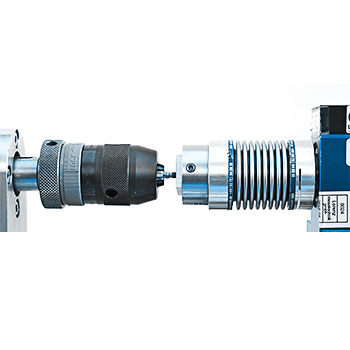
The assembled specimen is clamped in a torsional testing device and torque is continuously applied to the connecting part.
During loading, both torque and rotational displacement are recorded. This produces a torque versus rotation angle curve that describes the mechanical response of the implant connection.
The test is continued until the relevant maximum torque has been reached. At least six specimens are evaluated under the same test conditions.
Torsional yield strength
The torsional yield strength represents the point at which the connection begins to deviate significantly from its initial torsional behaviour.
ISO/TS 13498 determines this value from the torque versus rotation angle curve using a 2° offset method. The resulting torsional yield strength therefore provides a defined measure of the torque at which permanent rotational deformation of the connection begins to become relevant.
This value is particularly useful when comparing different connection geometries or materials because it describes the onset of non-linear mechanical behaviour rather than only the ultimate strength of the joint.
Maximum torque
The maximum torque is the highest torque recorded during the test.
It represents the maximum torsional load reached by the implant body/connecting part joint during the test and is determined directly from the recorded torque versus rotation angle curve.
Together with the torsional yield strength, the maximum torque provides a more complete description of the mechanical behaviour of the connection.
Failure assessment
After testing, the implant body/connecting part joint is examined under low magnification.
Any deformation or fracture of the tested components is documented. This additional assessment helps identify where and how the connection reached its mechanical limit and complements the numerical torque results.
Evaluation
The torsional yield strength and maximum torque are determined for each specimen, and the mean values of the tested specimens are calculated.
The results can be used to compare different implant connection designs, connecting parts or materials under standardized laboratory conditions.
ISO/TS 13498 does not specify universal acceptance criteria. The measured values therefore need to be assessed in relation to the implant design and the manufacturer’s defined requirements.