

























ASTM F1820

Disassembly forces of modular acetabular devices

Icon of the ASTM F1875 test

ASTM F1875

Fretting corrosion testing of modular implants – Femoral stem-head interface

Icon of the ASTM F2009: Standard Test Method for Determining the Axial Disassembly Force of Taper Connections of Modular Prostheses

ASTM F2009

Modular connection disassembly test

ASTM F2068 (PI-98)

Requirements for femoral prostheses - Metallic implants

ASTM F2345

Femoral head fatigue test

ASTM F2580

Modular stem fatigue test

ASTM F2582

Impingement test

ASTM F2979

Bearing surface characterization of retrieved hard-on-hard hip prostheses

ASTM F2996

FEA non-modular hip femoral stem

ASTM F3018

Guide for assessment of hard-on-hard articulation THR devices

ASTM F3047M

High demand hip wear testing

ASTM F3090

Fatigue test of acetabular devices

ASTM F3446

3D frictional torque measurement of total hip joint prostheses

ASTM F3738

Third-body hip wear test

ISO 11491

Impact resistance femoral heads

ISO 14242-1

Hip wear test

ISO 14242-4

Microseparation test

ISO 21534

Particular requirements for joint replacement implants

Icon of the ISO 21535 test

ISO 21535

Hip range of motion

icon test description

ISO 21535

Specific requirements for hip-joint replacement implants

ISO 7206-1

Classification and designation of dimensions

ISO 7206-10

Femoral head compression test

ISO 7206-12

Deformation test for acetabular shells

ISO 7206-13

Femoral head torsion test

ISO 7206-2

Hip surface analysis

ISO 7206-4

Femoral stem fatigue test

ISO 7206-6

Femoral stem neck fatigue test

ISO 7206-8

Femoral stem fatigue performance requirements

PI-11

Insert compression fatigue / static test

PI-3

Acetabular cup luxation test

PI-58 (ISO 7206-8)

Femoral stem fatigue test

PI-87

FEA non-modular hip femoral stem - neck region

PI-99 (ASTM F2091)

Standard specification for acetabular prostheses

PI-11

Insert compression fatigue / static test

Normative References

PI-11: Static/Dynamic Compressive Load Test – Hip Insert

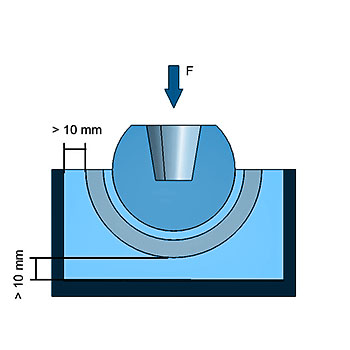
This internal test procedure describes the static and dynamic compression testing of modular hip cup inserts. Due to the variety of designs used clinically, modifications to this test procedure may be required for implants with special design features.

The applied loads and loading directions represent a simplification of the in vivo loading conditions. Special consideration shall be given to asymmetric implants and implants with special design features, as these may require modified and/or additional tests.

For the ultimate compression strength test, a static load is applied until specimen failure. For fatigue testing, a dynamic load is applied until either a predefined number of cycles is reached or failure occurs.

After fatigue testing, an ultimate compression strength test may be performed on ceramic inserts to evaluate post-fatigue compression strength. For polymeric inserts, a fixation strength test according to ASTM F1820 may be performed to evaluate post-fatigue fixation performance.

Implants with asymmetric geometries or special design features may require modified and/or additional testing. In such cases, defining the worst-case configuration can be challenging. Our specialists and FEA team can support you in identifying the relevant worst-case scenario and ensuring that the appropriate tests are performed for your device.

Resources

This image shows Dipl. Ing. Christian Findeiss Head of Fatigue Testing & Material Analysis, Head of Vascular Testing at EndoLab

Your contact person

Dipl. Ing. Christian Findeiss

Head of Fatigue Testing & Material Analysis, Head of Vascular Testing