









DIN EN 455-2: Medical gloves for single use – Part 2: Requirements and testing for physical properties
DIN EN 455-2 specifies requirements and test methods for the physical properties of medical gloves for single use. It applies to both surgical gloves and examination or treatment gloves and is intended to ensure that the gloves maintain sufficient physical performance during use.
The standard focuses primarily on glove dimensions and force at break. It also includes requirements for testing after accelerated ageing to assess whether the required mechanical properties are maintained over time.
EXECUTIVE SUMMARY
Testing according to DIN EN 455-2 evaluates whether medical gloves meet defined requirements for size and mechanical strength.
The main evaluations include:
- glove length and width
- force at break
- force at break after accelerated aging
For dimensional testing, 13 gloves from a production lot are assessed. The median values are compared with the specified requirements for the respective glove type and size. Force at break is also determined using 13 specimens prepared from gloves of the same lot. The test pieces are cut from suitable areas of the glove and tested under tensile loading until rupture.
Read more…
Purpose of the test
The purpose of DIN EN 455-2 is to verify the physical performance of medical gloves intended for single use.
The standard covers both surgical gloves and examination or treatment gloves. By defining requirements for dimensions and mechanical strength, it helps ensure that the gloves provide an appropriate fit and maintain sufficient integrity during their intended use.
Different glove materials can require different minimum force-at-break values. The standard therefore distinguishes between surgical gloves, examination gloves made from elastomeric materials, and examination gloves made from thermoplastic materials.
Dimensional testing
Glove dimensions are evaluated by measuring length and width without stretching the material.
For each production lot, 13 gloves are measured. The results are evaluated using the median value and compared with the dimensional requirements defined for the relevant glove type and size.
For surgical gloves, the standard specifies size-dependent requirements for both length and width. Examination and treatment gloves are classified into size categories ranging from extra small to extra large.
The dimensional requirements are intended to support appropriate fit and coverage during use.
Force at break
Mechanical strength is assessed by determining the force required to rupture a tensile specimen cut from the glove.
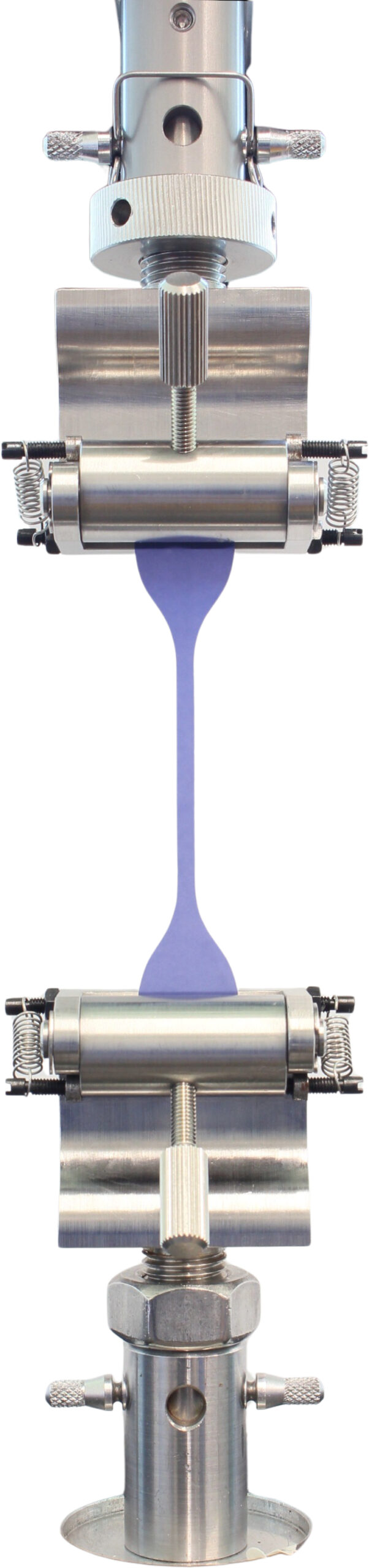
A shoulder-shaped test specimen is prepared from each of 13 gloves. Suitable areas include the palm, back of the hand or cuff, while textured regions should be avoided where possible.
After conditioning, the specimens are clamped in a tensile testing machine and loaded until rupture. The measured force at break is recorded for each specimen and the median value is used for evaluation.
If the glove material is significantly thinner at the fingertip than at the location from which the tensile specimen was taken, the measured result is corrected to account for this difference. This is intended to ensure that the reported mechanical performance remains representative of the mechanically critical areas of the glove.
Aging test
DIN EN 455-2 also evaluates the force at break after accelerated aging.
Gloves are exposed to elevated temperature for a defined period before the tensile test is repeated. This provides an accelerated assessment of whether the glove retains sufficient mechanical strength during its shelf life.
The required minimum force at break depends on the glove category and material. Separate requirements are defined for surgical gloves, examination gloves made from elastomeric materials, and examination gloves made from thermoplastic materials.
Evaluation
The test results are evaluated against the dimensional and mechanical requirements specified in DIN EN 455-2.
For the force-at-break test, the median result from the 13 specimens is compared with the applicable minimum requirement for the glove type and material.
The test report documents the glove type, material, production lot, test method and test results, together with any deviations or unusual observations made during testing.
Together, the dimensional and mechanical evaluations provide evidence that the gloves meet the physical performance requirements of DIN EN 455-2.