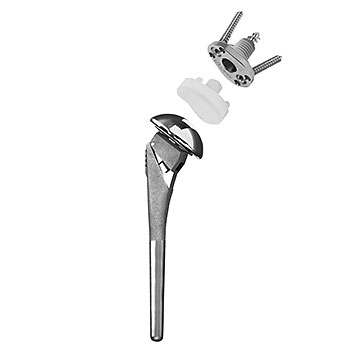

















ASTM F1378: Standard Specification for Shoulder Prostheses.
ASTM F1378 specifies requirements and evaluation principles for shoulder prostheses used in total shoulder arthroplasty and hemiarthroplasty. It applies to anatomic and reverse designs, including modular prostheses, but excludes devices manufactured for custom applications.
Rather than defining one universal test, the specification addresses several aspects of implant performance and design:
- Materials, corrosion resistance, and biocompatibility
- Minimum pre-implantation range of motion
- Wear performance of alternative bearing materials
- Strength of porous coatings
- Design-specific mechanical testing
- Glenoid locking, loosening, and disassociation
- Articulating surface finish, dimensions, marking, and labeling
The applicable evaluations depend on the implant design, materials, fixation method, modular connections, and anticipated failure modes.
Read more…
Scope and applicability
ASTM F1378 covers shoulder prostheses that provide an articulating joint through humeral and glenoid components. The specification encompasses anatomic and reverse total shoulder systems as well as shoulder prostheses intended for hemiarthroplasty. Modular prostheses are included.
The document classifies shoulder prostheses as constrained, partially constrained, or unconstrained according to the way the implant limits movement and resists dislocation. This classification, together with the component geometry and intended fixation, helps determine which mechanical evaluations are relevant.
Range of motion
The range of motion is evaluated before implantation to confirm that the prosthesis itself does not impose excessive restrictions on shoulder movement. ASTM F1378 specifies the following minimum values:
- Flexion: 90°
- Abduction: 90°
- Internal rotation: 90°
- External rotation: 45°
- Extension: 45°
These requirements are intended to reduce the risk that implant geometry restricts motion in a way that could contribute to dislocation or loosening.
Materials and biological considerations
Implant materials must provide adequate mechanical strength and durability, corrosion resistance, and biocompatibility. Selection of a recognized implant material alone does not demonstrate that the finished device will function adequately. Material properties must therefore be considered together with component geometry, loading, fixation, and the intended application.
For materials with limited or no history of successful orthopedic implant use, corrosion resistance is evaluated using ASTM F746. The new material is expected to provide performance equal to or better than established implant materials referenced by the specification.
Wear performance
The wear behavior of articulating surfaces must be considered. Under physiological test conditions, the alternative material combination should not exhibit a wear rate greater than the reference combination of cobalt-chromium-molybdenum alloy conforming to ASTM F75 articulating against ultra-high-molecular-weight polyethylene conforming to ASTM F648. Both reference surfaces must have prosthetic-quality finishes.
ASTM F1378 does not prescribe a device-specific shoulder wear test. However, there are testing standards for anatomic and reverse shoulder wear that should be considered.
Porous coating performance
Porous metallic coatings used on shoulder prostheses must be evaluated for both shear and tensile strength. ASTM F1378 refers to ASTM F1044 for coating shear testing and ASTM F1147 for coating tensile testing. These evaluations address the mechanical integrity of the coating attachment rather than the overall fixation performance of the implant.
Design-specific mechanical testing
The mechanical test program should reflect known clinical failures and potential failure modes associated with the particular prosthesis. Relevant areas may include:
- Subluxation
- Glenoid component loosening
- Dissociation of an insert from a metallic backing
- Humeral head dissociation
- Impingement or unsupported component surfaces during the intended range of motion
When defining test forces, loading directions, angles, and cycle counts, the manufacturer should consider the intended patient population, expected physiological loading, an appropriate safety factor, implant geometry, and the consequences of worst-case component configurations.
ASTM F1378 identifies normal shoulder joint reaction forces in the order of one to two times body weight as useful background for developing in-vitro tests. These values should not be applied without considering the implant design. Reverse shoulder systems may experience different loading directions, including increased superior shear at the glenoid component, and therefore require design-specific assessment.
Glenoid component testing
Anatomic modular glenoid implants with metallic or composite backing should be evaluated in accordance with ASTM F1829, which addresses the static shear performance of the locking mechanism.
All prosthetic glenoid components should withstand sustained static and dynamic physiological forces of up to one times body weight without loss of their intended function. Loosening testing should be performed for a clinically relevant number of cycles. ASTM F1378 identifies 100,000 cycles as a suggested basis, while recognizing that a higher cycle count may be necessary for worst-case conditions. ASTM F2028 provides a method for dynamic evaluation of loosening or disassociation for anatomic and reverse glenoid components.
For reverse systems, the specification notes that no dedicated standard method is available for evaluating humeral liner disassembly strength. Where this characteristic is relevant, suitable procedures from may be adapted and justified.
Surface finish and product identification
The main metallic bearing surface must have an average surface roughness, Ra, no greater than 0.10 µm. Where a polymeric bearing surface is used, its average surface roughness must not exceed 2 µm.
Components must be finished and marked in accordance with the applicable provisions of ASTM F86. Where space permits, marking information is prioritized as manufacturer, material, lot number, catalog number, and size. Orientation and side identification may also be included. A component that is not radiographically opaque should incorporate a suitable means of radiographic detection.
ASTM F1378 also defines dimensional information for anatomic humeral and glenoid components. The applicable dimensions and implant materials must be included in the product labeling.
Evaluation and limitations
Compliance is assessed against explicit requirements where ASTM F1378 provides defined limits, including range of motion and bearing surface finish. For wear and design-specific mechanical performance, the test rationale, specimen configuration, loading conditions, cycle count, worst-case selection, and evaluation criteria must be established for the implant under consideration.
The specification provides a framework for evaluating important factors affecting shoulder prosthesis performance, but it does not reproduce every aspect of long-term clinical use in a single laboratory test. Results should therefore be interpreted as part of the overall verification of the implant design, materials, fixation, and intended use.